Written by Lauren Borders & Juan Fernández Ochoa
Thumbnail photo submitted by Intercambios. A.C. (Argentina)
Support. Don’t Punish is a global, decentralised and grassroots-centred campaign that mobilises communities targeted by and resisting repressive drug policies. Under a common banner, we promote harm reduction and drug policies that prioritise health, human rights and well-being. This campaign reflects the growing movement against the ‘war on drugs’. We seek to raise the profile of harm reduction, decriminalisation and sustainable responses to drugs by strengthening communities’ organising capacity, opening dialogue with policy-makers, and raising awareness among the media and the public. Each year, campaign members unite for a Global Day of Action, advancing local action in transnational solidarity to bring about positive change.
Introduction
The 2025 Global Day of Action mobilised thousands of people across more than 80 countries for a timely demonstration of support for humane drug policy. Despite taking place under extraordinarily challenging conditions – including an unprecedented rollback of public funding and civic space – campaign members organised on an extraordinary scale through a diverse range of local actions. From facilitating access to harm reduction services to mural art, theatre performances, sports events, and policy dialogues, these actions showcase the resilience of our communities and the continued relevance of our message. Punitive drug policies are a net-negative approach, boosting criminalised economies and threatening the safety and well-being of our people. With hundreds of local partners in 262 cities, the Day of Action demonstrates the strength of grassroots leadership in resisting punitiveness and paving the way for better responses. Given evolving turbulence at the national and international levels, community organising is, now more than ever, a vital mechanism for catalysing change and asserting public need.
We are a diverse and united movement. In 2025, the Support. Don’t Punish campaign spearheaded new resources and toolkits for campaign members to support the operationalisation of key messages and UN standards, as well as a Leadership Network to inform campaign strategy. Our dual framework enables community-level action that reflects local issues and promotes democratic accountability, while maintaining a shared call for human rights, health, and well-being – empowering community voices and disrupting traditional structures of power in drug governance. Looking ahead, the campaign remains a reputable, powerful vehicle for advancing rights-based approaches to drugs. Capitalising on the momentum of this year’s Day of Action, the Support. Don’t Punish campaign aims to increase its presence in international dialogue through year-round campaigning. To stay engaged and amplify our collective voice, follow the Support. Don’t Punish campaign on social media and visit our website for updates, resources, and upcoming actions.

Reclaiming power through decentralised action
The Support. Don’t Punish campaign aims to turn the typical drug policy development pathway on its head. Punitive drug policies often develop in a top-down manner. International and domestic governance tend to push criminalising approaches without consent or consultation from affected communities. As a counterpoint, Support. Don’t Punish centres local voices, particularly those in countries most negatively harmed by the ‘war on drugs’. This year, approximately 85% of Global Day of Action grants went to community groups, and over 75% of actions receiving financial support took place in the Global South. Through these grants, the campaign powers creative and local activities across the world – from interactive art displays in Costa Rica to listening events with policy leaders in Uganda to harm reduction demonstrations in the UK. The campaign’s grassroots-focused structure is its biggest asset, and over the years has continued to generate ripple effects that ultimately create more conducive conditions for campaigning and advocacy, as well as to protect communities’ health and safety.
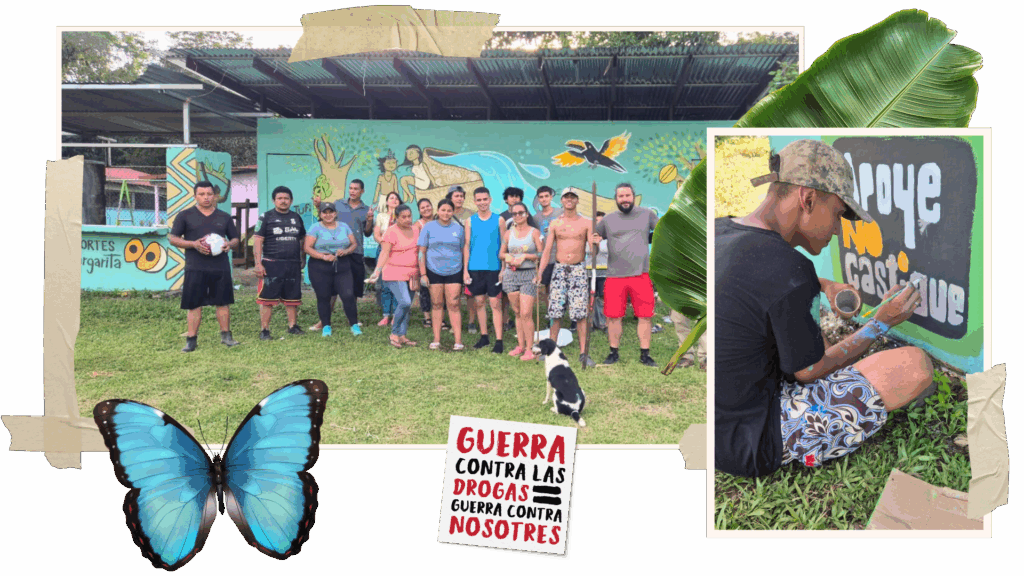
Young Maleku artists in Costa Rica co-created a mural and activities celebrating ancestral plant knowledge, challenging stigma, and linking culture with harm reduction and drug policy reform. Photos: ACEID
Campaigners developed a diverse range of actions, promoting our shared message and fostering critical relationships between organisations and local officials. These events championed health services through harm reduction trainings, screenings, and referrals; decriminalisation through arts and sports – developing murals, theatre productions and friendly matches with authorities; and collaboration with decision-makers through roundtables and workshops. Roughly half of campaigners reported positive media coverage from these initiatives, almost double our original goal. Ultimately, community partners concluded that the Global Day of Action not only supports community organising but also partnership building with institutional actors and convergent social justice movements. Members collaborated with organisers across movements, such as youth or LGBTQ+ groups, and forged new relationships with key decision-makers. This interconnectedness strengthens our efforts at a time when resilience and resistance are particularly needed in the face of political backlash.
The Global Day of Action demonstrates the power of grassroots leadership. When local actors use lived experience to collectively advocate for change, we move closer to equity. Our campaign actions expanded the profile of our campaign, forged meaningful connections between politicians and allies, and platformed the voices most vulnerable to criminalisation – providing key support for our campaign throughout the year. The old way of developing drug policy — behind closed doors and without affected communities — is certainly on its way out.

SSDP Kenya led peer dialogues and awareness actions in Nairobi, empowering young women who use drugs to break stigma and embrace harm reduction.
Strengthening skills and confidence
Support. Don’t Punish is not just a day of action but a sustained global movement. To that end, our campaign aims to strengthen the skills and confidence of its partners, empowering them to pursue change long after 26 June. Barriers to knowledge and influence between local and national or international organisations often hinder progress towards non-punitive drug policy. By investing in the capacity of local organisations, campaigners are empowered to engage in new advocacy methods and opportunities. Approximately 96% of partners reported gaining confidence to effect change, noting growth in facilitation, legal literacy, and media outreach skills.
Capacity-building occurred through on-the-ground collaboration and support from the central campaign team. The dissemination of new knowledge resources – including a multilingual Communications Guide and two toolkits on UN engagement – enhanced campaigners’ authority and reach. These resources offered guidance on communications strategy, language, social media usage, and the application of UN standards. Members learned how to effectively communicate their objectives and invoke human rights norms and standards for political change. The majority of campaigners reported using these resources, and the knowledge gained directly supported actions within their communities. Our designs and messages were broadcast across TV, radio, and newspaper outlets around the world. More than 80% of feedback respondents attracted new supporters, and many further developed existing relationships, leveraging connections to find venues, in-kind supplies, and co-hosting arrangements – particularly useful amidst the ongoing funding crunch. Campaigning actions facilitated practical knowledge development through hands-on activities and peer organisation. Several events far surpassed the expectations of the organiser, and, consequently, campaigners developed confidence in their own mobilisation skills.
Support. Don’t Punish is a diverse campaign with a coalitional ethos. In the face of funding cuts and political backlash, campaigners pooled resources, shared spaces, and partnered with sister movements. Local campaigns drew on centralised campaign resources, operationalised within their own specific context. Ultimately, capacity-building is not just about learning the political process but learning how to bring others into our growing movement. Campaign actions and resources promoted teamwork between members, external groups, and the broader community. These diverse and collaborative networks are key to strengthening resiliency within an evolving political climate.
Lessons
The Global Day of Action affirmed the value of unconventional tactics and solidarity. Our members organised an impressive range of actions, most well beyond the bounds of traditional formal advocacy and typical campaigning stunts. In a world of constant information, creativity can be disruptive. Arts, sports and practical interventions (e.g. harm reduction ‘demos’, referrals, screenings) all served as powerful tools for engagement. They displayed not only great ingenuity in their design but also great care for local communities and their needs. By combining connection and knowledge dissemination with tangible support, campaigners create accessible entry points for complex policy conversations.
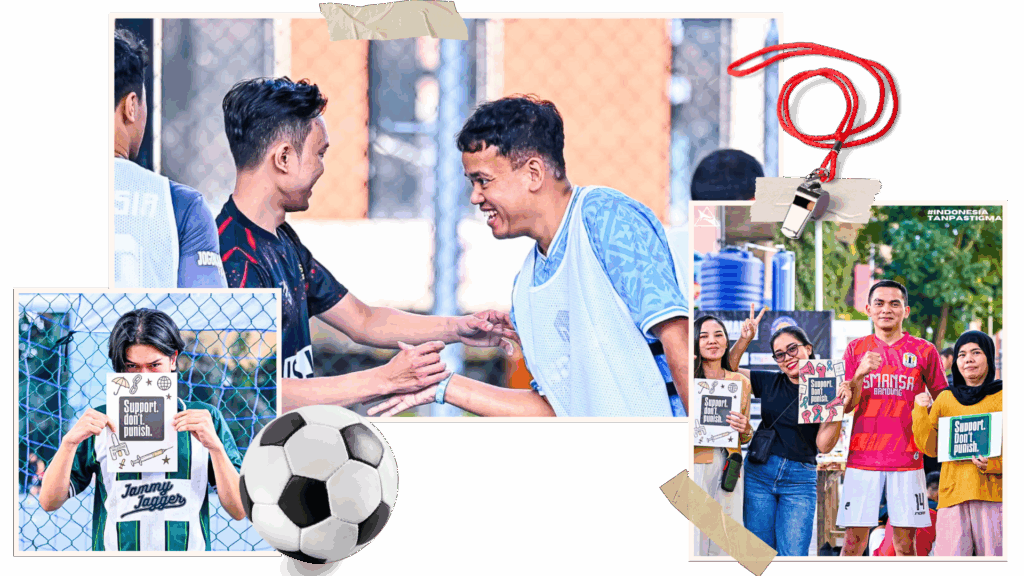
In Bandung, Indonesia, Rumah Cemara used a football tournament with local youth to foster camaraderie, open conversations on rights and decriminalisation, and build legal literacy.
Logistical constraints inspired new alliances, which broadened campaign reach and opened access to new resources. Often, drug policy discourse occurs within siloed groups; however, the Global Day of Action demonstrates that common ground can be found across sectors and issue areas. Members partnered with a number of external groups – medical associations, libraries, student groups, queer rights groups, etc. – to maximise resources and coordinate community-centred events.

In Colombia, Cultura Cívica Cannabica joined community groups Gestión Consciencia and the Biblioteca Negra Haile Selassie to host a Festival of Ancestral and Psychoactive Knowledge in Ibagué.
Nevertheless, challenges remain. Funding continues to be incredibly limited. Direct engagement with high-reach personalities also remains difficult, with some citing political hostility and media ‘gatekeeping’. While this signals possibilities to strengthen capacity in policy advocacy, media engagement and fundraising, local partners deployed solutions in the shape of coalitions, pooled resources and the use of campaign resources to mitigate these gaps.
Conclusion
Through the Support. Don’t Punish campaign, grassroots energy, creativity, and solidarity are fueling reform. The 2025 Global Day of Action demonstrated the power of decentralised, community-level organising. Participants put in place creative strategies that prioritised local issues and expanded campaign visibility. They resourcefully mitigated funding and resource constraints through collaboration with cross-sector partners and community stakeholders. Through the success of these actions and capacity-building support from the central campaign team, local partners strengthened their advocacy skills and campaigning confidence. Overall, this day highlights the values of unconventional tactics and solidarity. Through creative community engagement and collaboration with new partners, members are reaching wider audiences and asserting influence in the face of adversity. As the international political context grows increasingly uncertain, these lessons will be critical in effecting change that centres lived experience and equity.
Ultimately, the Global Day of Action remains a credible, powerful vehicle for rights-based drug policy, and an example of bottom-up reform in contexts where it is most needed.
However, our efforts do not end here. The spirit and inspiration of the Global Day of Action remain at the forefront of our long-term campaign strategy. Moving forward, the campaign will support four seasoned groups through the Initiatives Programme, restructure its existing Leadership Network, develop peer-to-peer channels of communication, and produce further knowledge and advocacy resources to sustain campaign progress. To combat new finance challenges, we will also recruit a new Fundraising Consultant to diversify our funding base and continue to sustain local partners’ stellar work. These objectives bolster our campaign’s momentum, strengthen governance and resources, and develop donor capacity – supporting not only next year’s Global Day of Action but action all year long.
