Momentum for our movement: Introducing the 2025 Initiatives Programme
Our movement is experiencing a contradiction. On one hand, campaigners have won major victories: UN resolutions recognising harm reduction for the first time, greater public understanding of the human rights implications of drug policy, strengthened community leadership. On the other hand, funding for harm reduction is in peril and anti-rights politics are closing space for progress and dissent.
Against this backdrop, the Initiatives Programme of the Support. Don’t Punish campaign remains a vital tool for resourcing community power. Now in its fifth edition, the Programme provides modest but strategic grants that support ambitious work, strengthens leadership, and translates global wins into local action. This year, all four initiatives are led by returning awardees — a deliberate choice to deepen momentum in a turbulent landscape.
What we learnt from last year’s initiatives
Last year’s cohort shared a range of achievements cutting across context, political realities and organising traditions. Initiatives Programme awardees are shifting narratives and public understanding. In Colombia, the legal education work by Mujeres Libres — led by formerly incarcerated women championing alternatives to imprisonment — has ‘contributed to transforming narratives around women deprived of liberty’, changing hearts and minds among the general public and public institutions, away from punishment and towards rights. In Zambia, the Harm Reduction Zambia Network led community education and harm reduction workshops that have increased understanding and weakened taboo and stigma.
Local partners have also witnessed stronger alliances and opened new spaces for dialogue. Across countries, deeper ties with and between communities have built productive collaborations. In Myanmar, DPAG’s intersectionality workshops and creative community forums have created precious opportunities to create lasting ties and common understandings between harm reduction advocates, LGBTQI+ activists, youth, and recovery groups. Similarly, the HRZN reported relationship-building as a major achievement, connecting key decisionmakers with affected communities.
Some initiatives secured concrete policy wins. AFRILAW’s national campaign against the death penalty for drug offences — through press conferences, media advocacy and direct engagement with human rights bodies — contributed to the removal of capital punishment in the amended NDLEA Bill, mitigating the harshest injustice in the proposed legislation.
Initiatives Programme awardees also shared generously about their experience in strengthening leadership. Many noted how the Programme enabled more grounded, community-led facilitation. Mujeres Libres highlighted how meaningful and empowering peer-led legal workshops inside of prisons have been, for instance.
And the work is far from finished. Across regions, partners stressed pending challenges in terms of the dearth of sustained funding sources, enduring stigma and misinformation, as well as political hesitancy and instability. As colleagues from IDUF put it, ‘sustainable funding is essential to ensure the continued success and impact of advocacy efforts’. These gaps and challenges are frustrating but energising, speaking to our movement’s commitment to persevering.
The 2025 Initiatives Programme cohort
This year’s group of four change-making organisations were selected to further develop already established relationships, deepen momentum where openings exist, protect gains in fragile environments, amplify developing community leadership and prepare for the 2026 Global Day of Action — our movement’s yearly show of force. Each project contributes to a loca and national ecosystem of reform meaningfully shifting the dial in the direction of further justice.
In Costa Rica, ACEID is strengthening Indigenous, youth-led harm reduction
With this year’s award, ACEID continues to work with young Maleku people who use drugs in northern Costa Rica to indigenise harm reduction and anchor it in community knowledge and practice. Building on previous intercultural harm reduction circles, this year’s programme focuses on deepening youth leadership through scholarships and structured training in harm reduction and peer education.
A cohort of young Maleku people have been supported to undertake virtual harm reduction training, complemented by community-based workshops that integrate peer care and project development skills. Despite a challenging political climate and insecurity affecting participation, the project has adapted its methodology to prioritise trust-building and community safety. Early signs of impact include strengthened confidence among youth participants and the emergence of new community leadership grounded in lived experience.
In Colombia, Mujeres Libres leads the charge for justice, dignity and alternatives to incarceration for women in prison
Mujeres Libres continues to support the implementation of the Ley de Utilidad Pública, which creates pathways for women criminalised for drug-related offences to access non-custodial measures. Led by formerly incarcerated women, the organisation has consolidated its role as a key bridge between affected communities and state institutions. During the first months of the project, Mujeres Libres convened and moderated the first inter-institutional meeting on implementation of the law, bringing together the Ministry of Justice, the Ombudsperson’s Office and civil society actors. The organisation also supported strategic litigation challenging restrictive interpretations of the law — a case now accepted for review by Colombia’s Constitutional Court. Women benefiting from the law have directly participated in dialogue with judicial authorities, centring lived experience in national policy conversations. This work demonstrates how community organising can translate into institutional recognition and tangible reform pathways.
In Myanmar, DPAG doubles down on the value of intersectional organising
In a context of shrinking civic space, DPAG continues to create rare and necessary spaces for intersectional organising. Building on prior cross-movement collaboration between harm reductionists, LGBTQ+ activists, mental health practitioners and rural leaders, this year’s work includes qualitative research in the nightlife and entertainment sector, youth-led digital engagement, and community events developed in collaboration with allied campaigns. By anchoring harm reduction in broader social justice conversations, DPAG is strengthening networks that cut across issue silos and fostering a culture of collective care and resilience. The programme also demonstrates early signs of resource diversification, with complementary funding secured for community-led events.
In Germany, BerLUN flies the flag of migrant-led harm reduction
BerLUN continues to address gaps in harm reduction and healthcare access for migrant communities in Berlin. The project has delivered training on non-stigmatising language and harm reduction principles, while initiating structured dialogue with district-level political actors. Preparations are underway for a community-led photo exhibition, ‘Moments of Positivity,’ created by people who use drugs and designed to combine psychosocial empowerment with advocacy engagement. As an organisation entirely led by people who use or have used drugs and who have migrant backgrounds, BerLUN models peer legitimacy and lived-experience leadership as a core strategy for eroding stigma and advancing health equity.
We need you!
The campaign’s lifetime evaluation showed local partners’ participation develops mobilisation and advocacy capacity with concrete impacts. 73% of surveyed partners reported contributions to changes in policies and practices. And yet austerity, foreign-aid cuts, and anti-rights politics are destabilising hard-won gains. Many partners are struggling to remain operational.
The Initiatives Programme is a lifeline protecting wins, strengthening leadership, offering a laboratory for creative ideas, and building powerful alliances. Without long-term support, these breakthroughs risk stagnation.
To keep this work alive, become a supporter of the campaign — all donations are invested into community-led and/or Global South projects. Amplify their stories and successes. Wear the colours of the campaign and share it with others.
Change is happening. Let’s resource it!
Call for applications
The fifth edition of the Support. Don’t Punish campaign’s Initiatives Programme focuses on sustaining and enhancing momentum built by campaign partners at the local and national level — including through their involvement in prior editions of the Programme.
By focusing on organisations that have previously been awarded by the Programme, we seek to more effectively navigate a challenging funding environment, and to help consolidate achievements, strengthen leadership, and ensure that existing progress is leveraged for continued growth.
The 2025 edition of the Initiatives Programme will award USD 4,500 to four projects for activities to be implemented between October 2025 and June 2026. Local partners are free to design proposals that are strategic, creative and collaborative — with work plans that culminate with commemorations for the 2026 Support. Don’t Punish Global Day of Action.
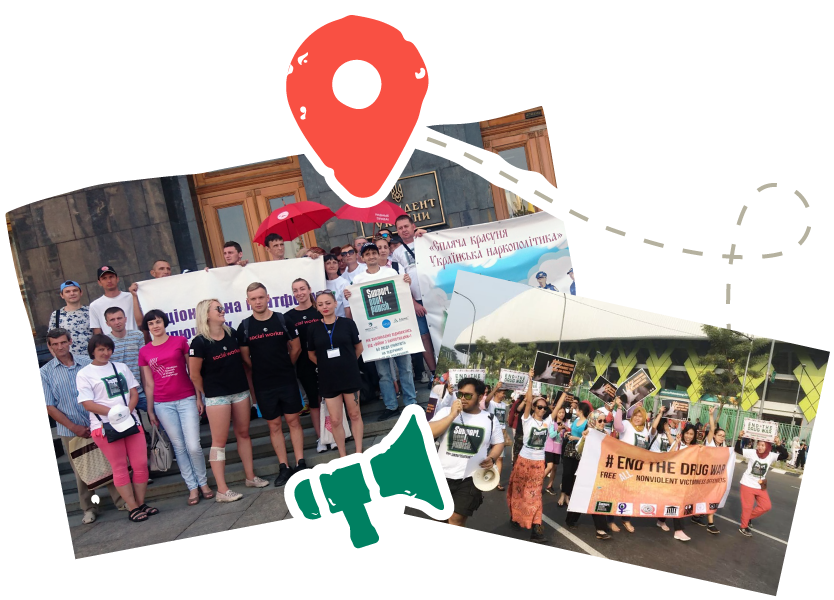
Map of Initiatives Programme awardees (2019-2024)
The Initiatives Programme is possible thanks to the invaluable support of the Elton John AIDS Foundation, which enables our global campaign to promote harm reduction, protection from police violence and other rights abuses, and grassroots mobilisation.
What we are looking for
We will receive applications for initiatives that:
- Build on prior work to consolidate achievements and further develop momentum;
- Concretely contribute to advancing drug policy reform and harm reduction — identifying specific challenges and responding to them strategically, creatively and collaboratively.
- Amplify the voices and leadership of communities disproportionately affected by punitive drug policies (e.g. people who use drugs, farmers of crops deemed illicit, youth, racialised communities, Indigenous peoples, LGBTQ+ people, among others);
- Inspire meaningful change in attitudes, policies or practices — through advocacy, cultural action, community mobilisation, or other forms of organising.
How to apply
Applications should be submitted via the Call for Expressions of Interest, available here, by Monday, 22 September 2025 (noon – UK time).
Please keep responses concise and specific.
Timeframes
- 26 August 2025 – Launch of the Call for Expressions of Interest
- 22 September 2025 – Deadline to apply
- 22–26 September 2025 – Review of applications
- 3 October 2025 – Notification of results
- 6–10 October 2025 – Period for drafting terms of reference and disbursement
- October 2025 – June 2026 – Implementation of initiatives, culminating in activities for the 2026 Global Day of Action (26 June)
- July 2026 – Period for feedback, accountability and reflection